Women in STEM: The Facts, the Gap, and Why It Matters for Every Child
Women in STEM (Science, Technology, Engineering and Mathematics) remain underrepresented despite decades of progress. Explore the data, the barriers, and what parents and educators can do to close the gender gap.
The Curious Crew
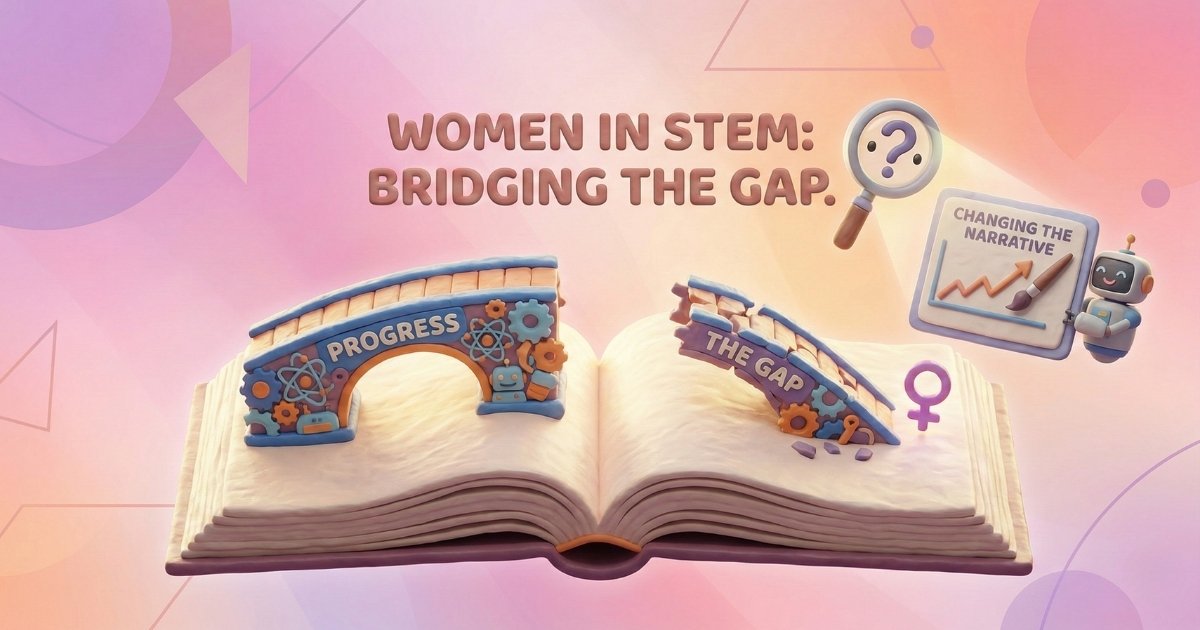
Women in STEM have shaped the modern world, from Marie Curie's pioneering work in radioactivity to Katherine Johnson's calculations that sent astronauts to the Moon. Yet today, females in STEM still represent a minority of the global scientific and technological workforce. Understanding why and what we can do about it matters for every child growing up curious.
The Global Picture: Women and STEM by the Numbers
The data paints a clear picture. According to UNESCO's Science Report (2021), women make up just 33% of researchers worldwide. In some regions, the figure is far lower.
The World Economic Forum's Global Gender Gap Report (2024) highlights that at the current rate of progress, full gender parity in STEM professions will not be reached for several generations. Women and STEM representation has improved since the 1970s, but the pace of change has slowed considerably in the last decade.
In the United States, the National Science Foundation (NSF) report "Women, Minorities, and Persons with Disabilities in Science and Engineering" (2023) shows that while women earn approximately 50% of STEM bachelor's degrees overall, they remain heavily concentrated in biological and social sciences. In computer science, women earn just 26% of bachelor's degrees; in engineering, it is 24%.
Where Are Women in STEM Fields Today?
Women in STEM fields are not evenly distributed across disciplines. The disparities become sharper as you move into specific sectors:
- Life sciences and health: Women represent 67% of wage employees in the health and care sector globally, a notable success story driven by decades of access improvements. (WHO & ILO, 2022)
- Computer science and AI: Females in STEM fields like artificial intelligence hold only 22% of positions globally, according to the World Economic Forum (2024).
- Engineering: Women represent roughly 15-20% of the engineering workforce in Europe and North America. (European Commission, She Figures 2021)
- Physics and mathematics: One of the most persistently male-dominated areas, women remain a minority in physics and mathematics globally. (UNESCO Science Report, 2021)
These numbers matter because the industries shaping the future artificial intelligence, climate technology, biotechnology, and space exploration are being built right now. If females in STEM are underrepresented in these fields, the technologies and solutions they produce will be shaped by a narrower range of perspectives.
Why the Gap Persists
The barriers facing women for STEM careers are well-documented and operate at multiple levels:
- Early socialisation: The OECD PISA 2022 study shows that while boys outperformed girls in mathematics by 9 points on average, this modest gap does not explain why girls express significantly lower confidence in and interest in pursuing STEM careers, pointing to socialisation rather than ability as the primary barrier.
- Stereotype threat: A landmark study by Spencer, Steele & Quinn (1999) demonstrated that awareness of gender stereotypes alone can reduce women's performance on mathematics tests, a phenomenon replicated in dozens of subsequent studies.
- Lack of visible role models: Children cannot aspire to what they cannot see. When textbooks, media, and popular culture overwhelmingly portray scientists and engineers as male, girls receive an implicit message about who "belongs" in those spaces.
- Workplace culture: A Pew Research Center study (2018) found that 50% of women in STEM jobs have experienced gender discrimination at work, including harassment, being treated as incompetent, and lack of support from senior leaders, systemic issues that push women out of STEM careers mid-career, the so-called "leaky pipeline" problem.
The #WomenInSTEM Movement
The womeninstem movement widely recognised by its hashtag across social media has become a powerful platform for visibility and advocacy. Initiatives like the UN International Day of Women and Girls in Science (11 February) and Girls Who Code are actively working to close the gap through mentorship, community building, and early engagement.
These movements matter because representation creates a feedback loop: when girls see women in STEM succeeding, they are more likely to see themselves in STEM futures. The #womeninstem community now spans millions of posts, connecting researchers, students, educators, and advocates worldwide.
What the Research Says About Early Intervention
Perhaps the most important finding for parents and educators is this: the STEM gender gap does not begin in university. It begins in childhood.
A study published in the journal Science by Bian, Leslie & Cimpian (2017) found that by age six, girls are already less likely than boys to describe their own gender as "really, really smart", a belief that directly correlates with interest in STEM subjects.
A large-scale study commissioned by Microsoft (2018), surveying more than 6,000 girls and young women across the United States, identified that girls' interest in STEM typically peaks at early age, during school ages. The most effective interventions happen before that window closes through hands-on experiences, relatable role models, and stories that normalise curiosity in science for everyone.
What Parents and Educators Can Do
Encouraging women for STEM starts long before career choices. Here are evidence-based actions:
- Expose children to diverse role models early: Books, stories, and media featuring women in STEM fields have a measurable impact on aspirations. The Curious Crew designs characters who model scientific curiosity regardless of gender.
- Use inclusive language: Instead of "boys are good at maths," try "anyone can be good at maths with practice." Language shapes belief.
- Prioritise hands-on exploration: Let all children build, experiment, code, and question without gendered expectations about what they "should" enjoy. Explore our guide to STEM sets and hands-on education.
- Challenge media stereotypes together: When a film or book only shows male scientists, talk about it. Ask: "Who is missing from this story?"
- Celebrate process over perfection: Research shows girls are more susceptible to fear of failure in STEM. Praising effort and curiosity, not just correct answers builds resilience.
Why This Matters for Curious Minds
At The Curious Crew, we believe curiosity has no gender. Every child, regardless of who they are deserves to grow up believing that science, technology, engineering, and mathematics are spaces where they belong.
The numbers tell us that females in STEM fields are still underrepresented. But the research also tells us that early intervention works. Stories work. Role models work. Conversations work. Discover what schools get wrong about STEM and how to fix it.
If we want the next generation of scientists, engineers, and innovators to reflect the full diversity of human curiosity, we need to start now, with the questions we ask, the stories we tell, and the futures we help children imagine.
Further Reading and Resources
- UNESCO Science Report 2021 - The Race Against Time for Smarter Development
- NSF - Women, Minorities, and Persons with Disabilities in Science and Engineering (2023)
- World Economic Forum - Global Gender Gap Report 2024
- Bian, Leslie & Cimpian (2017) - Gender stereotypes about intellectual ability emerge early (Science)
- UN International Day of Women and Girls in Science