The Battery Town Joins the STEM Discovery Campaign 2027
The Battery Town is going into classrooms through the STEM Discovery Campaign 2027. Here is what the campaign is, and what its 2026 edition achieved: more than 9,000 activities and over a million participants in 50+ countries.
The Curious Crew
What is the STEM Discovery Campaign?
The STEM Discovery Campaign is the most prominent of the campaigns organised by Scientix, the community for science education in Europe. Scientix is an initiative of European Schoolnet.
During the campaign, participants share their STEM education activities on a clickable world map, from where the community can access and reproduce them. Originally a weeklong event, the campaign has run every year since 2020 from the beginning of February to the end of April.
The 2026 edition was a joint international initiative co-organised with the NBS Academy project. It invited educators, projects, organisations, libraries, schools, universities, youth clubs and all interested stakeholders across Europe and beyond to celebrate careers and studies in Science, Technology, Engineering and Mathematics (STEM). It ran from 1 February to 30 April 2026, with a peak of activities from 25 to 30 April.
Anyone organising, contributing to or attending an activity that promotes STEM can pin it on the STEM Discovery Campaign map, through the Scientix portal or the STEM Discovery mobile app. An activity can take many forms: organising or attending an event, implementing a learning scenario, attending or organising a workshop, festival or webinar, inviting speakers to a class, or running a project-like activity and discussing the outcomes with students.
Everyone who submits to the map is eligible for one or more Scientix Awards, which celebrate outstanding achievements of educators in science education.
The 2026 campaign in numbers
9,000+
activities organised
1,000,000+
participants
200,000+
educators
800,000+
students
50+
countries
For comparison, the 2016 campaign counted 94 activities and 2,191 participants.
The partners
The partners of the 2026 campaign included well-known companies and foundations such as Microsoft, the Airbus Foundation, Lenovo, Cisco, TikTok, Britannica Education, Cummins and Timken, as well as Clarios and VARTA.
Partnership is open to public and privately funded projects, governmental and non-governmental organisations, universities, libraries, youth clubs, companies and schools active in STEM education. Partners agree to organise and share STEM activities as part of the campaign, to encourage others to organise their own and mark them on the campaign map, and to publish information supporting the campaign on their websites. In return, their logo and web link are displayed in the campaign’s partner banner and in the STEM Discovery Campaign app.
The Scientix Awards 2026
In 2026, the Scientix Awards were organised in six areas, each containing several awards: Arts and Culture, Environmental Sustainability, Research and Careers, Technology, Whole School, and Community. For many of the awards, the prize was an invitation to the Science Projects Workshop (SPW) in Brussels.
Many of the awards were supported by the campaign’s partners, among them:
- Scientix AI Navigators Award, supported by Microsoft and the Airbus Foundation, with one stream on AI literacy and one on the safe use of AI in class.
- Scientix Waste to Wonder Award, supported by Lenovo, for STEM projects that creatively reuse simple waste materials such as cardboard and packaging.
- Scientix Science in Action Award, supported by TikTok, for short science demonstration videos.
- Scientix Teamwork Award, supported by SMART Technologies, which also offered a one-year Lumio SPARK licence to all award winners.
- Scientix Next-Gen Shapers Award, supported by Cummins, for secondary school teachers who show their students the careers available in STEM.
The Scientix Circular Technology Award was supported by Clarios. It recognises educators who bring the circularity principles of “reduce, reuse, recycle” to life in STEM learning, helping students understand the full lifecycle of technologies such as batteries and other energy storage systems. Two learning scenarios created in partnership with Clarios, Mission Voltra and From STEM Learning to Sustainable Action, were offered as inspiration. Besides the invitation to the Science Projects Workshop, the prize includes 1,000 EUR for the school of each of the two winners, to carry out a sustainability activity of their choice. The 2026 award went to Nektarios Farassopoulos and Kalliopi Xagorari from Greece, for “Running Batteries”, and to Maria Andrada Muntean from Romania.
More ways to take part
Alongside the map and the awards, the 2026 campaign listed other opportunities to join, for example:
- The STEAMbrace STEAM Week, from 16 to 20 February 2026, for schools and students aged 11 to 18, with each day dedicated to a different STEM field combined with the arts.
- The Look Up – Cloud Hunters 2026 competition, inviting students aged 5 to 11 and their teachers to observe clouds and contribute to real scientific research through the GLOBE Observer app.
- The Leonardo4Children 2026 Awards, inviting children and young people to submit original projects that combine creativity, art and science.
- Creative Classrooms with AI: Innovate Responsibly, a free, open course for teachers on using AI to support creativity in the classroom.
The STEM Discovery Campaign 2027
Scientix has announced the STEM Discovery Campaign 2027, and its full programme is still to be published. What is already known:
- The timing. Since 2020, the campaign has run every year from the beginning of February to the end of April.
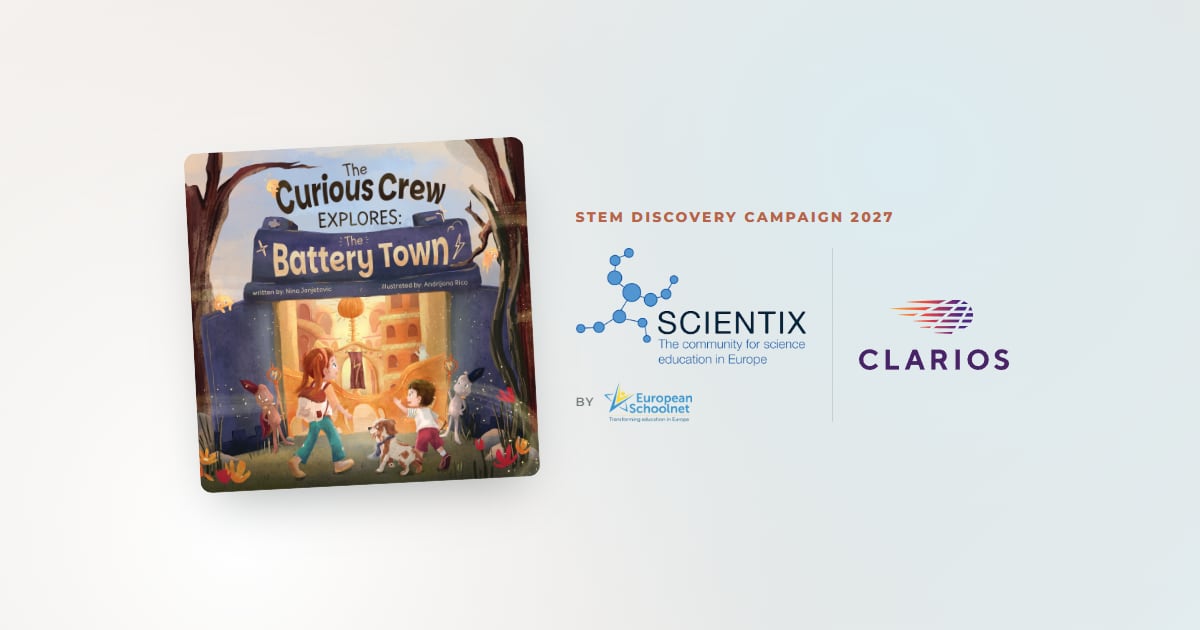
- The Battery Town in the classroom. As part of the 2027 campaign, Scientix and Clarios will provide primary school teachers attending the Science Projects Workshop 2027 with The Curious Crew Explores: The Battery Town, so they can bring it straight into the classroom.
We will share more as Scientix publishes the details of the 2027 campaign.
Sources: STEM Discovery Campaigns, Scientix Awards, 2026 events, 2026 partners and 2026 STEM Discovery Campaign results, Scientix.