Europe's Growing STEM Skills Gap: Why Early Curiosity Is the Answer
Too many young Europeans leave school without solid maths and science skills. With STEM enrolment far below 2030 targets, early curiosity-driven learning is more urgent than ever.
The Curious Crew
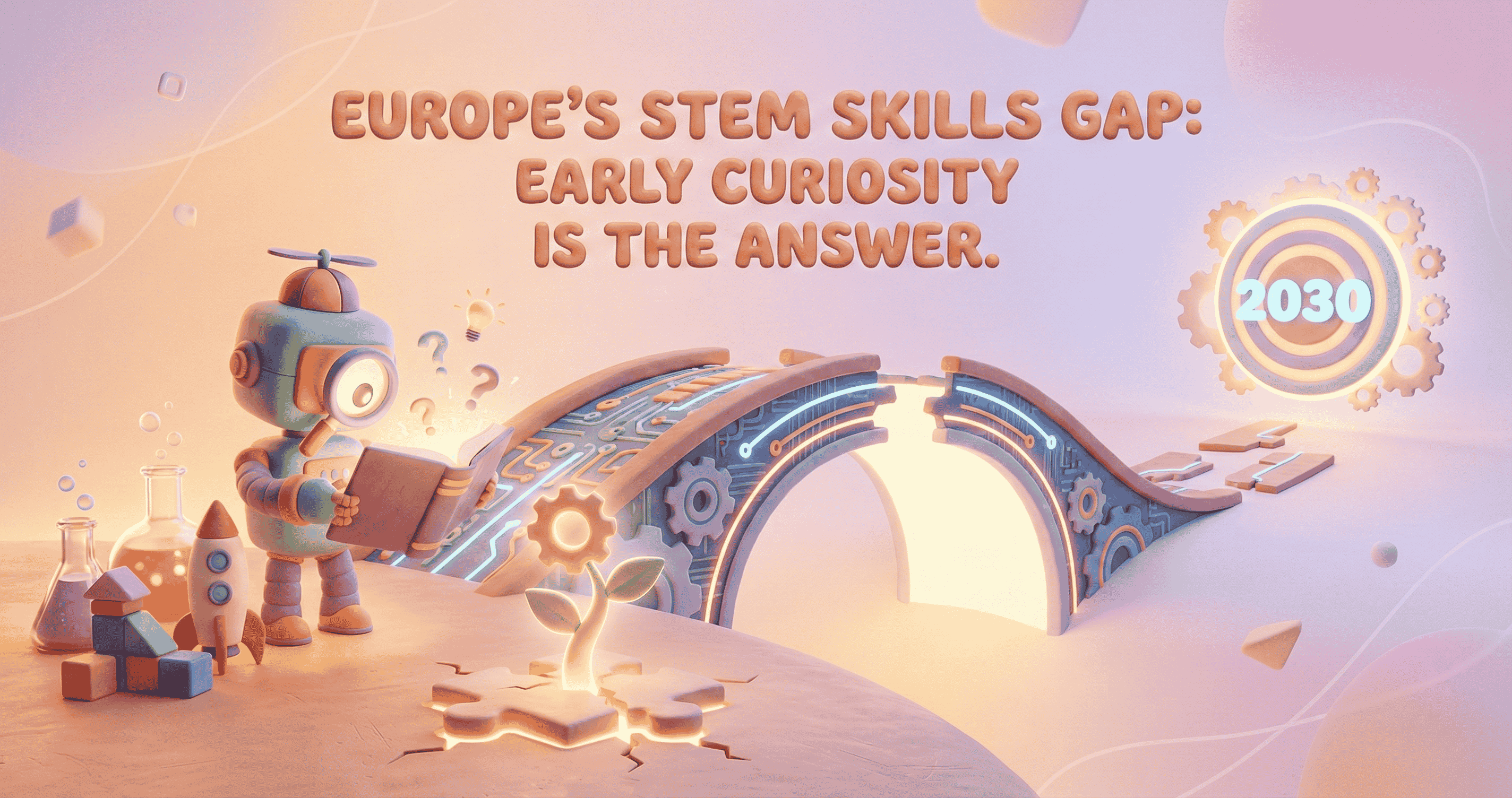
Europe has a problem it cannot afford to ignore. Too many young people are leaving compulsory education without solid basic skills in mathematics and science, the very foundations needed for further STEM studies and meaningful participation in the labour market. The consequence is a persistent and widening shortage of STEM skills and professionals, one that undermines Europe's competitiveness and slows down the digital transition the continent urgently needs.
The numbers tell a sobering story. The share of students enrolled in STEM subjects remains well below the EU's own 2030 targets: just 36.3% in vocational education and training (VET) against a target of 45%, and only 26.9% at the higher-education level against a target of 32%. The shortages are sharpest in the fields that matter most for the future: engineering and information and communications technology (ICT).
Understanding why this gap exists and what can be done about it is essential, not just for policymakers and educators, but for every parent, caregiver, and organisation that wants to prepare the next generation for the world they will inherit.
The Scale of Europe's STEM Challenge
The European Commission's Education and Training Monitor 2024 provides the clearest picture of where Europe stands. The report tracks progress against EU-level education benchmarks and confirms that STEM enrolment across both VET and higher education is falling short of the targets set for 2030.
At the VET level, where practical, occupation-specific STEM training is delivered, current enrolment sits at 36.3%, nearly nine percentage points below the 45% target. At the higher-education level, which feeds the research and innovation pipeline, the gap is narrower but still significant: 26.9% against a 32% target. These are not marginal misses. They represent structural shortfalls that, if left unaddressed, will compound over time.
The Eurostat tertiary education statistics add further detail. In 2023, engineering, manufacturing and construction accounted for 14.7% of all tertiary students in the EU, while information and communication technologies represented just 4.7%. Within engineering, nearly three quarters (72.3%) of students were male. In ICT, the imbalance was even more pronounced, with 79.7% of students being men. These figures reveal not only a volume problem but a diversity problem: too few students overall, and far too few women in the fields where demand is highest.
The Basic Skills Crisis That Feeds the Pipeline Problem
The STEM enrolment gap does not appear out of nowhere at university or VET entry. It begins much earlier, in compulsory education, where too many young Europeans are failing to acquire the basic mathematics and science skills they need to even consider a STEM pathway.
The OECD's PISA 2022 study found that mean performance in mathematics across OECD countries fell by a record 15 points between 2018 and 2022, the largest decline ever recorded. Reading scores dropped by 10 points, twice the previous record. While science performance remained relatively stable on average, the overall trajectory is deeply concerning.
In reading and mathematics, the downward trend had been developing for a decade, but the post-pandemic period accelerated it dramatically. Across the OECD, socio-economically disadvantaged students were seven times more likely than advantaged students not to achieve basic mathematics proficiency. These gaps do not close on their own. Without intervention, a child who falls behind in mathematics at age 10 is far less likely to choose, let alone succeed in, a STEM pathway at 16 or 18.
This is the pipeline problem: if children leave primary and lower secondary school without confidence and competence in maths and science, the pool of potential STEM students at VET and university shrinks before it even forms.
Why This Matters for Europe's Future
The STEM skills gap is not an abstract educational concern. It has direct consequences for Europe's economic competitiveness, digital sovereignty, and capacity to address the great challenges of the 21st century.
The digital transition demands professionals who can build, maintain, and innovate with technology: software engineers, data scientists, cybersecurity experts, AI researchers, and the technicians who keep critical infrastructure running. The green transition requires engineers, materials scientists, and energy specialists. Healthcare needs biomedical researchers and health technologists. Every sector of the economy is becoming more dependent on STEM capabilities.
When the supply of STEM graduates falls short of demand, several things happen:
- Companies struggle to fill critical roles, slowing innovation and growth.
- Europe becomes more dependent on talent from outside the continent, creating vulnerabilities in strategic industries.
- The digital divide deepens, as communities and regions without STEM capacity fall further behind.
- Young people miss out on well-paid, future-proof careers, reinforcing cycles of inequality.
The EU's 2030 targets for STEM enrolment were not set arbitrarily. They reflect a calculated assessment of the skills Europe needs to remain competitive in a world where technology increasingly defines economic and geopolitical power.
Where the System Breaks Down
The reasons for Europe's STEM shortfall are complex and interconnected, but several key factors stand out:
- Early disengagement from maths and science. Many children develop negative attitudes toward mathematics and science during primary school years. When these subjects are taught through rote procedures and high-stakes testing rather than exploration and genuine inquiry, children learn to associate them with anxiety rather than curiosity.
- Lack of connection to the real world. STEM subjects are often taught in isolation from the contexts that make them meaningful. When a child cannot see why algebra, physics, or biology matters to their life, motivation evaporates.
- Gender and socio-economic barriers. Girls continue to be underrepresented in engineering, computing, and physics, not because of ability but because of persistent stereotypes, lack of role models, and socialisation that steers them away from these fields. Learn more in our article on women in STEM: the facts, the gap, and why it matters. Children from disadvantaged backgrounds face additional obstacles: fewer resources, less exposure to STEM professionals, and school environments that may not prioritise STEM enrichment.
- Fragmented VET systems. Vocational education and training remains undervalued in many European countries compared to academic pathways. When VET is seen as a second choice rather than a high-quality route to skilled employment, it struggles to attract the volume and calibre of students needed to meet STEM targets.
- Teacher shortages in STEM subjects. Many European education systems face a shortage of qualified maths and science teachers, particularly at the primary and lower secondary levels where foundational attitudes are formed. Our article on innovative teaching methods for STEM explores what teachers need to succeed.
The Case for Curiosity-First STEM Education
If the problem begins early, so must the solution. The evidence is clear: the most effective way to build a larger, more diverse STEM pipeline is to ensure that all children develop confidence, competence, and genuine interest in mathematical and scientific thinking from the earliest years.
This does not mean pushing formal STEM curricula onto younger children. It means fostering the curiosity, questioning, and exploratory behaviour that are the natural precursors to scientific thinking. Children who grow up asking "why?" and "what if?" are children who see STEM not as a set of difficult school subjects, but as a way of understanding the world.
At The Curious Crew, this is the philosophy that drives everything we do. Our books, conversation starters, and educational resources are designed to build the habits of mind that underpin STEM readiness: asking questions, testing ideas, embracing uncertainty, and learning through exploration. We do not teach children what to think. We help them practise how to think.
What Parents, Educators, and Organisations Can Do
Closing Europe's STEM gap requires action at every level, from EU policy to individual households. Here are evidence-based approaches that make a difference:
- Start early and start with wonder. Introduce mathematical and scientific thinking through play, stories, and hands-on exploration long before formal education begins. Children who associate STEM with curiosity and fun are far more likely to pursue it later. Explore how STEM sets and hands-on learning can help.
- Make STEM visible and relatable. Show children the real people who use maths and science in their work: engineers, doctors, game designers, environmental scientists. Representation matters. When children can see someone who looks like them in a STEM role, aspiration becomes real.
- Support teachers. Invest in training and resources that help primary and secondary teachers deliver engaging, curiosity-driven STEM education. The quality of teaching in the early years is the single most important factor in shaping attitudes toward maths and science.
- Elevate vocational pathways. Communicate clearly that VET in STEM fields is a high-value, respected route to skilled employment, not a consolation prize. Highlight success stories and career outcomes to shift perceptions.
- Address gender and inclusion gaps directly. Use inclusive language, diverse role models, and deliberate programme design to ensure that girls and children from all backgrounds feel welcome in STEM spaces.
- Pair stories with science. Narrative is one of the most powerful tools for making abstract concepts accessible and memorable. When a child encounters a scientific idea through a story, they engage with it emotionally as well as intellectually, and that engagement sticks.
How The Curious Crew Is Contributing
We believe that every child, regardless of where they live, what language they speak, or what school they attend, deserves the chance to develop genuine confidence in mathematical and scientific thinking. Our resources are designed to work alongside formal education, filling the curiosity gap that too often leaves children disengaged from STEM before they have had a real chance to explore it.
For families, our books and Pocket Curiosity conversation prompts make it easy to weave STEM thinking into everyday life, at the dinner table, on a walk, or before bed. For schools and organisations, we develop bespoke programmes that integrate storytelling with hands-on STEM learning, designed to reach the children who are most at risk of disengagement.
Europe's STEM skills gap will not close itself. But if we invest in curiosity now, in the early years when attitudes are forming and possibilities are still wide open, we can build a generation of young people who do not just study STEM because they have to, but because they genuinely want to.
And that is where lasting change begins.